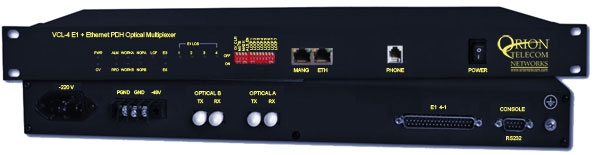
E2,
Opti-Multiplexer
Product
Description
E2, Opti-Multiplexer
(4E1) is an Integrated OLTE and multiplexer / demultiplexer unit, based
on PDH (Plesiochronous Digital Hierarchy) technology. It multiplexes
four 2.048 Mbps (hereafter referred to 2Mbps) E1 tributaries into
a single 8 Mbps, E2 stream and then transports it as
|
 |
| an optical signal
on a Single Mode, 1300nm optical fiber cable, without the use of any
signal repeaters up to a distance of over 50 KM. The multiplexer / demultiplexer
also does the reverse processing i.e. demultiplexing a received optical signal into four
2Mbps E1 tributaries. |
Orion's Opti-Multiplexer solution multiplexes, 4 E1
stream into one 8 Mb signal and then transport it on a 1300 nm Single Mode Optical Fiber
pair. On the de-multiplex side, it receives the optical signal and de-multiplexes it into
4, electrical E1 signals.
The card uses one E1 quad line unit for
interfacing to E1 streams. This device provides data and extracted jitter free clock
meeting the G.703 standards. The jitter attenuater meet G.735 specifications. The
multiplexer device provides for in-built DPLL circuits for recovery of received E1 clocks.
The device provides various alarm conditions as per draft G.775 recommendations. These
include loss of signal at E1, loss of signal at E2, loss of frame sync at E2, detection of
AIS at E2 and bit error exceeding 1 in 1000. The output of the mux chip is connected to E2
line interface unit which provides the HDB3 coder along with clock extraction. The control
functions are carried out by a micro controller.
|

|
- +5V DC present
- -48V DC present
- Loss of signal at 2Mbps - channel 4
- Loss of signal at 2Mbps - channel 3
- Loss of signal at 2Mbps - channel 2
- Loss of signal at 2Mbps - channel 1
- AIS at 8Mbps
- Optical signal - Sync
Green = Sync., Optical
signal present.
Red = Loss of Sync., Optical signal absent. |
The power supply module accepts-48V DC
input and provides 5V output required for the operation of the card.
|
Features |
Highlights |
- A compact solution that performs E1 to E2 multiplexing and
de-multiplexing and provides an 8Mbps optical interface (8Mbps OLTE) in a single card
- Conforms to ITU recommendations G.742
- Performs Second order Mux as per G.742
- Loss of signal and AIS detection as per G.775
- Tributary and higher order loop backs supported
- Supports tributary loopbacks for commands received from far end based
on stuff bit polarity
- Single-card implementation
- Highly reliable and compact.
- Standard CCITT Interfaces
- Class I Laser.
|
- Remote and local terminal monitoring and control through a PC Com
port using VCL-Opti-Multiplexer, Network Management System.
- Extensive alarms and status indication facility.
- Operates on nominal - 48V DC input
- Distributed on-board power supply.
- Microprocessor controlled with powerful diagnostic facilities for
both remote and local systems.
- Local and remote loopback facility for the 8Mbps stream for
diagnostics.
- Programmable auto-laser shut down feature for greater safety.
- Capable of synchronizing on any of the clock sources
- internal, or extracted (loop-timed).
|
E2, Integrated 8 Mbps OLTE and
Multiplexer

External Interfaces and
Connectors
VCL Opti-Multiplexer unit provides the following
interfaces to the external world:
- 4, Primary rate 2Mbps & 120 Ohms balanced E1 interfaces
- 1300nm, Single Mode optical fiber interface, Tx and Rx through
FC/PC Connectors
- -48V input for on-board power supply
- RS232 interface for connection to Network Management System,
used for configuration and monitoring of the Opti-Multiplexer system.
- 2 External alarm extensions for visual and audible alarms.
|
Alarms
The equipment provides the following alarms through visual
indication
- Power supply failure alarm
- Higher order loss of signal alarm
- Higher order AIS indication alarm
- Loss of frame sync alarm
- Bit error rate alarm
- Loss of signal alarm for each tributary
- Remote alarm
The equipment provides the following alarms
and monitoring facilities through visual indications and Windows based GUI.
- Loss of Digital Signal (TLOS)
- Optical signal detection (SIG-DET)
- BER3
- BER6
- Laser Bias Current (LBIASC)
- Optical Loss of frame (OPLOF)
- End of Life Detect (Optical module)
- Optical Transmit disable (OPTITXDIS)
- Auto-Laser Off
- Prompt Alarm
- Loop Back detection
- The equipment provides for loop backs for diagnostic purposes
These alarm condition except PSU failure, are
extended to the bay top by two potential free make contacts. These alarms, optionally, are
also transmitted over the RS232C serial link.
Loopbacks
The card provides option to
exercise the following
- Remote alarm send
- Individual tributary remote loopbacks
- Higher order local loopback
- Higher order remote loopbacks
These options can be exercised through RS232
interface and in addition through this port it is possible to inject PRBS pattern on any
of the tributaries and also to check the received PRBS pattern on any tributary.
Others Links
Technical specifications are subject to change without
notice.
All brand names and trademarks are the property of their respective owners.
|